




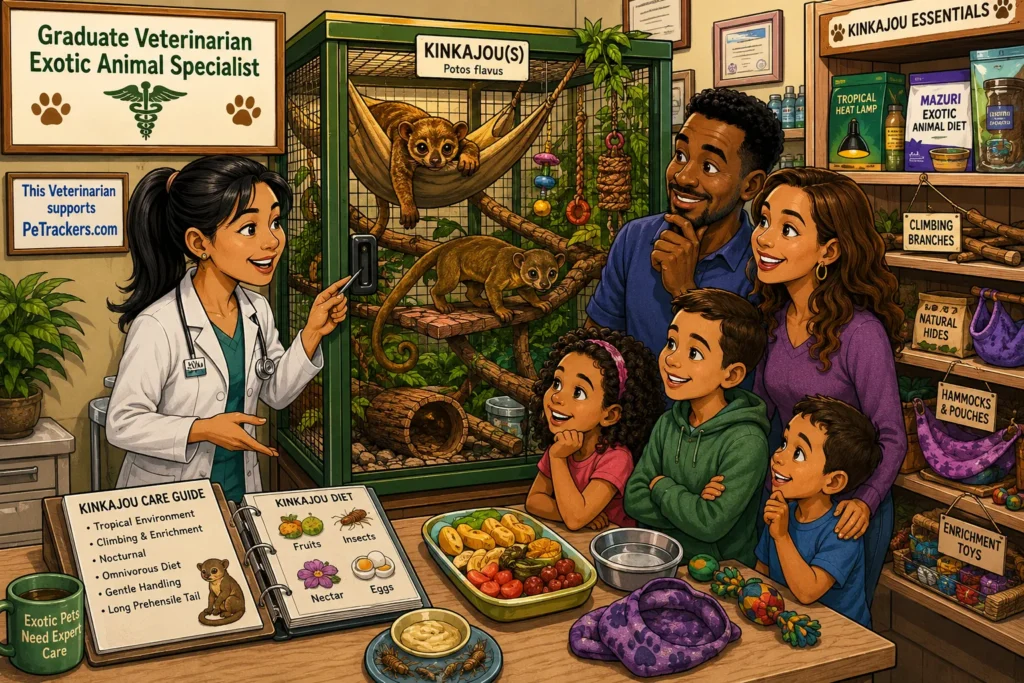
Kinkajous as a Pet
Considerations before Committing

- Housing Requirements
Kinkajous as a Pet
- Enclosure Size for your pet Kinkajous:
- Captive Kinkajous need extremely large enclosures to climb
- Captive Kinkajous need extremely large enclosures to jump
- Captive Kinkajous need extremely large enclosures to exercise
- The minimum recommended Kinkajous enclosure size is 6 feet high by 8 feet wide and 5 feet long
- Ideally combining both an Kinkajous indoor and outdoor enclosure
- Escape-proof locks and secure doors are essential for your pet Kinkajous
Outdoor flooring should be concrete beneath natural substrates to prevent digging and simplify cleaning.
- Temperature & Humidity for your pet Kinkajous:
- Kinkajous are highly sensitive to cold
- Kinkajous do not tolerate temperatures under 15.5°C (60°F)
- As Kinkajous Owner you must maintain a tropical environment between 23.8°C and 29.4°C (75°F to 85°F)
- Maintain Kinkajous heat requirements utilizing heat emitters or safe heating elements
Tropical humidity levels help maintain your pet Kinkajous healthy skin and respiratory systems.
- Materials for your Pet Kinkajous housing:
- Choose Kinkajous enclosures with a wire spacing of no larger than 1″ x 2″
- Kinkajous flooring should be concrete for outdoor spaces
- Kinkajous flooring should be linoleum/easily cleanable surfaces indoors
- This permits your pet Kinkajous flooring should be managing their natural scent glands
- Sleep Boxes for your pet Kinkajous :
- Kinkajous are crepuscular/nocturnal
- Kinkajous require a dark, enclosed, and insulated sleeping box
- Or nest where your pet Kinkajous can hide during the day
- Food Requirements
Kinkajous as a Pet
Dietary Makeup for your pet Kinkajous
- Kinkajous are primarily frugivores
- 90% of your pet Kinkajous wild diet is fruit
- Kinkajous’ meals should consist of a variety of fresh fruits like melons
- Kinkajous’ meals should consist of a variety of fresh fruits like apples
- Kinkajous’ meals should consist of a variety of fresh fruits like bananas
- Kinkajous’ meals should consist of a variety of fresh fruits like mangos Kinkajous meals should consist of a variety of fresh fruits like papayas Kinkajous meals should consist of a variety of fresh fruits like grapes
- Protein for your pet Kinkajous:
- Supplement fruit for your pet Kinkajous with protein such as cooked chicken
- Supplement fruit for your pet Kinkajous with protein such as scrambled eggs
- Supplement fruit for your pet Kinkajous with protein such as high-quality monkey/primate biscuits
- Kinkajous also love honey and nectar
- What to Avoid for your pet Kinkajous:
- Never feed your pet Kinkajous avocados (which are toxic)
- Never feed your pet Kinkajous dairy
- Never feed your pet Kinkajous chocolate
- Never feed your pet Kinkajous onions
- Never feed your pet Kinkajous broccoli
- Never feed your pet Kinkajous most citrus fruits
- Serving Tips for your pet Kinkajous:
- Kinkajous are messy eaters
- Kinkajous often prefer to eat hanging upside down
- Kinkajous often prefer to eat on their backs
- Use heavy ceramic dishes or metal bowls that lock securely onto the cage
You can also use terminal branch feeding – hiding food on ropes and high branches – to simulate Kinkajous wild foraging.
- Water Requirements
Kinkajous as a Pet
Freshwater Access for your pet Kinkajous
- Fresh water for your pet Kinkajous must be provided
- Fresh water for your pet Kinkajous must be easily accessible at all times
- Check your pet Kinkajous water systems daily to ensure proper operation
- Dispenser Style Water System for your pet Kinkajous:
- Do not use open water dishes
- Kinkajous will quickly dump
- Kinkajous will quickly spill
- Kinkajous will quickly dirty them
- Instead, use a sturdy hanging water bottle for your pet Kinkajous
Make sure the sipper tube for your pet Kinkajous is metal and designed to prevent dripping.
- Enrichment Requirements
Kinkajous as a Pet
Puzzle feeders and hidden treats for your pet Kinkajous encourage natural foraging behaviors.
- Your pet Kinkajous require thick branches
- Your pet Kinkajous require ropes
- Your pet Kinkajous require hammocks
- Your pet Kinkajous require climbing shelves
Regular enrichment is necessary to prevent boredom and destructive behaviors from your pet Kinkajous.
- Check Local Laws First
Kinkajous as a Pet
Before considering Kinkajous ownership:
- Verify local and provincial regulations regarding Kinkajous as a pet
- Some areas restrict or prohibit private ownership of Exotic Kinkajous mammals
- Some areas require Kinkajous permits
- Some areas have special Kinkajous housing requirements
Proper housing is absolutely essential for your pet Kinkajous.
- Questions to Ask a Breeder
Kinkajous as a Pet
Before purchasing a pet Kinkajous ask:
- Was the Kinkajous animal captive-bred?
- Has the Kinkajous received veterinary examinations?
- What foods is the Kinkajous currently eating?
- Has the Kinkajous been socialized with people?
- Is there a Kinkajous health guarantee?
- What support is offered after the Kinkajous purchase?
Meeting the Kinkajous animal several times before bringing the Kinkajous home is always a wise decision.
Family Considerations
Kinkajous as a Pet
A Kinkajous may be suitable if your family:
- Has experience with exotic animals
- Can provide large, climate-controlled housing
- Is comfortable with a pet that is awake mostly at night
- Has access to an exotic-animal Veterinarian
- Can commit to decades of care
A Kinkajous may not be suitable if your family wants:
- A cuddly daytime companion
- A low-maintenance pet
- An animal that enjoys constant handling by children
- A pet that can be left alone for long periods
For many families visiting Kinkajous at – licensed wildlife facilities or sanctuaries – may provide the enjoyment of these remarkable Kinkajous rain-forest mammals – without the significant responsibilities of private Kinkajous Ownership.
Your Emergency Photos/Video on
PeTrackers.com
Made it Easier to Find
And Quicker to Reunite
Your lost Pet Kinkajous
To You Safely