

Goat Beauty Contests
Goat as a Pet
Most “Goat Beauty Contests” are officially called goat shows – breed shows – or conformation shows – Judges are not simply choosing the cutest or most colourful goat – Judges compare each Competition Goat with the ideal standard for its breed – age – sex – purpose -dairy – meat – fibre – miniature – or companion.
- Goat Entry Rules
Goat as a Pet
- Beauty Contest Entry and Identification pet Goat:
- The goat’s registered name
- The goat’s breed and sex
- The goat’s date of birth
- The goat’s registration or pedigree papers
- The goat’s permanent identification – such as an approved ear tattoo – tag – microchip
- The goat’s Owner and Breeder information
- The goat’s required health records
- Registered Goat breed classes may require:
- The goat’s original registration documents
- Mixed-breed Goats or unregistered Goats may be permitted only in designated:
- Commercial goats
- Pet goats
- Companion goats
- Youth goats
- Goats open classes
- Goats are normally divided into fair classes:
- So that very different animals are not judged directly against one another
5 Goat competition classes may be separated by:
- Goat’s breed
- Goat’s age
- Goat’s sex
- Goat’s size
- Goat’s production type
- Whether a Goat Doe has previously given birth
- Health Requirements
Goat as a Pet
Every Goat should arrive healthy alert and fit to compete – a Goat may be refused entry or removed for negative health signs such as:
- Fever
- Persistent coughing
- Nasal discharge
- Diarrhea
- Contagious skin disease
- Ringworm
- External parasites
- Abscesses
- Serious lameness
- Open wounds
- Severe underweight condition
- Any suspected infectious disease
Some Goat beauty contests require a Veterinary inspection before unloading or entering the show area – owners should not disguise illness – injury – lameness – scars – physical defects.
- Grooming Rules
Goat as a Pet
Goats should generally be:
- Clean
- Properly brushed
- Free of excessive manure and dirt
- Presented with healthy skin and coat
- Groomed appropriately for their breed
Dairy and meat goats are often clipped according to show traditions.
Fibre goats may be presented with their natural fleece because judges need to assess fibre quality.
Over-grooming that conceals faults may violate show rules.
- Artificial Appearance Enhancement
Is Strictly Prohibited
A legitimate Goat Beauty Contest normally judges the goat’s natural qualities – not cosmetic alterations – depending on the organization – prohibited practices may include:
- Injecting fillers
- Using implants
- Artificially changing body shape
- Surgically altering appearance solely to gain an advantage
- Dyeing markings to misrepresent natural colour
- Painting over defects
- Applying substances that conceal scars or skin problems
- Artificially enlarging muscles
- Using unauthorized hormones or drug
- Altering teeth to misrepresent age
- Falsifying registration or identity
Ordinary Goat washing, brushing, permitted clipping, hoof trimming, and approved coat conditioners may be acceptable.
- Hooves must be Properly Maintained
Goat as a Pet
Goat hooves should be trimmed before the show so the Goat can stand and walk naturally – Judges may penalize:
- Overgrown hooves
- Uneven hoof trimming
- Poor foot structure
- Weak pasterns
- Lameness
- Abnormal movement
Do not trim the Goat Hooves aggressively immediately before the competition -excessive trimming can make a Goat’s hooves sore.
- Horn Requirements
Vary By Beauty Show
Rules differ significantly between organizations:
- Some Goat Dairy shows require goats to be naturally hornless or properly disbudded.
- Other Goat Breed shows permit natural horns.
- Youth competitions may require horns to be removed or safely blunted.
- Never alter horns merely for a show without checking the official rules and discussing animal welfare with a veterinarian.
- What Goat Judges Examine
Goat Beauty Contest
Judges usually observe the goat standing and walking – common qualities include:
- Overall balance
- Breed character
- Healthy body condition
- Strong feet and legs
- Correct movement
- Levelness and strength through the topline
- Width and structure of the chest
- Body depth and capacity
- Proper shoulders
- Strong loin
- Correct rump structure
- Healthy coat and skin
- Alert but manageable behaviour
The ideal appearance differs according to the Goat’s purpose. – Judges use the relevant Goat Breed or Production Scorecard rather than one Universal Standard.
- Dairy goats Judges commonly emphasize:
- Dairy strength and character
- Body capacity
- Strong feet and legs
- A well-supported mammary system
- Udder balance
- Strong udder attachments
- Appropriate teat placement
- Evidence of productive longevity
A Dairy Goat should look strong and capable rather than excessively fat – the stage of lactation and age may also be considered.
- Meat goats Judges commonly look for:
- Muscling
- Width
- Length of body
- Strong loin
- Broad rump
- Adequate chest and brisket
- Structural correctness
- Sound movement
The Goal is not simply the heaviest goat – balance – health – structure – useful muscling matter.
- Fibre Goats Angora, Cashmere, and other fibre Goats may be judged on:
- Fibre quality
- Fineness
- Length
- Density
- Uniformity
- Crimp
- Coverage
- Cleanliness
- Overall body structure
Fibre Goats are often presented clean and carefully brushed without disguising the natural quality of the coat.
- Miniature or Companion Goats Judging may emphasize:
- Breed type
- Proportion
- Structural soundness
- Healthy condition
- Coat quality
- Temperament
- Manageability
Some companion classes use a separate scorecard rather than judging the goat as a dairy or meat animal.
- Showmanship may be Judged Separately
Goat Beauty Contest
In a conformation class – the goat is primarily judged – in a showmanship class – the Goat Handler is judged on how well the Goat Handler prepare – control – present the Goat.
The Goat Handler may be expected to:
- Enter calmly
- Keep an appropriate distance from other goats
- Lead without dragging
- Keep the goat positioned correctly
- Watch the judge
- Move promptly when instructed
- Present the goat’s best view without blocking the judge
- Answer questions about the goat
- Remain courteous
A beautifully prepared goat can still place poorly in Showmanship if the Goat’s Handler is inattentive or handles it roughly.
- Goat Behaviour and Control
Goat Beauty Contest
A Competition Goat should be reasonably manageable – Judges understand that Goats may jump – call – resist – become distracted – however a dangerous or uncontrollable Competition Goat behaviour may result in removal.
Handlers should not:
- Allow goats to fight
- Crowd other Goat competitors
- Deliberately distract another Competition Goat
- Block the judge’s view
- Use excessive force to make the Competition Goat stand
- Common Judges Reasons
For Penalties or Disqualification
Goat Beauty Contest
Depending on the Goat show, these may include:
- Incorrect Competition Goat registration
- Entering the wrong Competition Goat class
- False Competition Goat identification
- Missing Competition Goat health documents
- Contagious disease
- Severe lameness Competition Goat
- Serious Competition Goat structural defects
- Breed Competition Goat disqualifications
- Unauthorized cosmetic alteration Competition Goat
- Prohibited drugs
- Mistreatment Competition Goat
- Unsportsmanlike conduct Handler
- Refusing Competition Goat official inspection
- Dangerous behaviour Competition Goat or Handler
- Humane Treatment is Mandatory
Goat Beauty Contest
Competition Goats must be treated calmly and humanely throughout the event – usually prohibited are:
- Hitting or kicking Competition Goats
- Dragging a Competition Goat
- Twisting Competition Goat ears or tails
- Excessive force Competition Goat
- Painful Competition Goat restraint
- Deliberately frightening the Competition Goat
- Withholding Competition Goat necessary water
- Exhausting the Competition Goat before judging
- Using irritating substances to make the Competition Goat appear more alert
The Competition Goat’s welfare should take priority over winning.
- Competition Goat Awards
Goat Beauty Contest
A typical competition may progress through:
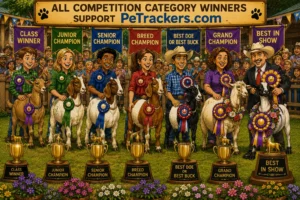
- Class Winner → Junior or Senior Champion → Breed Champion → Best Doe or Best Buck → Grand Champion → Best in Show
- Not every show uses these titles.
- Some fairs award separate championships for dairy, meat, fibre, miniature, companion, and youth divisions.
- The most important rule is:
- That a goat should win because it is healthy
- That a goat should win because it is naturally presented
- That a goat should win because it is structurally sound
- That a goat should win because it is representative of its breed
- That a goat should win because it is and responsibly handled
- That a goat should win because it is not because faults were hidden or its appearance was artificially exaggerated
Your Emergency Photos/Video
You Instantly Released on
PeTrackers.com
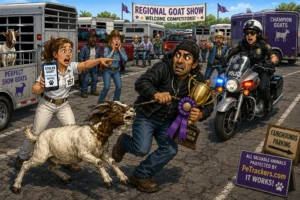
Made Finding your Stolen Prize Goat
Quicker and Easier to Find
And Happily Return to You!