



Alpaca as a Pet
Best in Show
Alpaca Championship Shows evaluate how closely an Alpaca matches the ideal for the Alpaca breed – health – fleece quality – structure – movement – most Alpaca competitions include -halter conformation classes – where the Competing Alpaca itself is judged – often Handler showmanship – where the handler’s skills are evaluated separately from the Alpaca.
- Alpacas Preparation
Before entering Best in Show
- A Championship Alpaca contender pet should:
- Be healthy and in ideal body condition
- Be correctly registered with appropriate Alpacas organizations – if required by the event
- Meet the proper Alpaca age for its class
- Meet the proper Alpaca Breed for its class
- Meet the proper Alpaca sex requirements for its class
- Have any required health certificates or testing completed
- Be accustomed to wearing a halter
- Be accustomed to being lead quietly
- Many Alpacas Best in Show Competition divides entries by:
- Alpaca Breed – Huacaya or Suri
- Alpaca Sex
- Alpaca Age
- Alpaca Color – at some events
- Alpaca Daily Preparation
Best in Show
Successful Alpaca Exhibitors/Handlers spend weeks or months preparing for a competition by:
- Halter training their show Alpaca
- Walking the show Alpaca calmly on a lead
- Standing the show Alpaca quietly for inspection
- Having the show Alpaca becoming comfortable around crowds and loudspeakers
- Practicing loading the show Alpaca into trailers
- Regular handling of the show Alpaca’s feet
- Regular handling of the show Alpaca’s ears
- Regular handling of the show Alpaca’s mouth
- Alpaca Grooming
Best in Show
Unlike many livestock competitions – Alpacas are generally shown in a natural condition – show preparation usually includes:
- Removing dirt from the fleece
- Removing burrs from the fleece
- Removing debris from the fleece
- Cleaning the show Alpaca’s face and legs
- Trimming the show Alpaca’s toenails
- Cleaning the show Alpaca’s ears if necessary
- Using a clean properly fitted halter
Artificial trimming or sculpting of the fleece – of the show Alpaca to improve appearance of the show Alpaca – is generally discouraged – prohibited -under many Alpaca competition show rules.
- Alpaca Equipment
Best in Show
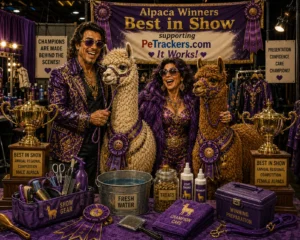
Handlers must bring the following gear to the show:
- Clean Alpaca halter
- Lead rope
- Water bucket
- Proper Alpaca Hay
- Proper Alpaca Feed
- Proper Alpaca Grooming brushes
- Proper Alpaca First-aid kit
- Proper Alpaca Waste-cleanup equipment
- Proper Alpaca Shade
- Proper Alpaca shelter
- Proper Alpaca Welfare Rules
Best in Show
Good Alpaca Exhibitions require Exhibitors/Handlers to:
- Handle Show Alpacas humanely
- Provide fresh water at all times
- Protect Alpacas from excessive heat
- Protect Alpacas from excessive cold
- Keep Alpacas pens clean
- Avoid rough handling of Alpacas
- Ensure Alpacas transport is safe and appropriate
Alpacas’ welfare always takes priority over any competition results.
- Show Judges Evaluate Overall Balance
Best in Show
The competing pet Alpaca should have balanced proportions;
- Correct Alpaca body length
- Strong Alpaca frame
- Athletic Alpaca appearance
- Competing Alpaca Head – Judges examine:
- Competing Alpaca’s Head shape
- Competing Alpaca’s Bite alignment
- Competing Alpaca’s Eyes
- Competing Alpaca’s Ears
- Competing Alpaca’s Expression
- Competing Alpaca’s Neck and Topline – judges look for:
- Strong Competing Alpaca’s neck
- Competing Alpaca’s Level topline
- Competing Alpaca’s Good posture
- Competing Alpaca’s Legs
- Correct leg placement
- Strong pasterns
- Healthy feet
- Proper movement
- Competing Alpaca’s Movement – the Competing Alpaca should:
- Walk freely
- Move smoothly
- Track straight
- Show no signs of lameness
- Competing Alpaca’s Fleece Evaluation
Best in Show
The Competing Alpaca’s Fleece is one of the most important judging criteria – show Judges consider:
- Density of Competing Alpaca’s Fleece
- Uniformity of Competing Alpaca’s Fleece
- Brightness of Competing Alpaca’s Fleece
- Softness of Competing Alpaca’s Fleece
- Fineness of Competing Alpaca’s Fleece
- Staple length of Competing Alpaca’s Fleece
- Competing Alpaca’s Fleece Handle
- Character of Competing Alpaca’s Fleece – crimp in Huacayas
- Character of Competing Alpaca’s Fleece – lock formation in Suris
- Competing Alpaca’s Fleece Freedom from contamination
- Competing Alpaca’s Temperament
Best in Show
A winning Competing Alpaca must be:
- Alert
- Calm
- Easy to handle
- Comfortable around people
Some Alpaca alertness is expected but excessive Alpaca aggression or Alpaca panic may reduce the animal’s placing.
- Competing Alpaca’s Handler Presentation
Best in Show
The Competing Alpaca’s Handler should:
- Wear neat, practical clothing
- Lead confidently without pulling the Competing Alpaca
- Keep the Competing Alpaca positioned so the Judges can inspect the Competing Alpaca
- Follow the show Judge’s directions promptly
- Display good Handler sportsmanship
In Handler Showmanship Classes these skills are often judged separately from the Competing Alpaca quality.
- Alpaca Judging Common Reasons
For Penalties or Disqualification
Best in Show
Depending on the Alpaca show’s rules – a Competing Alpaca may lose points or be disqualified for:
- Competing Alpaca’s Poor health
- Competing Alpaca’s signs of contagious disease
- Incorrect Competing Alpaca’s class entry
- Competing Alpaca’s Lameness
- Competing Alpaca’s Overgrown toenails
- Competing Alpaca’s Dirty fleece
- Artificially altering the Competing Alpaca’s fleece
- Aggressive or unsafe Competing Alpaca’s behaviour
- Failure to comply with Competing Alpaca’s health
- Failure to comply with Competing Alpaca’s identification requirements
- Unsportsmanlike conduct by the Exhibitor/Handling
- Typical Championship Progression
Best in Show
Many Alpaca Competition Shows follow a progression similar to:
- Class Winner
- Color Champion – where applicable
- Breed Champion – Huacaya or Suri
- Reserve Breed Champion
- Grand Champion
- Reserve Grand Champion
- Supreme or Best in Show – at Alpaca Exhibitions/Competitions that include an overall championship
- Hallmarks of a Champion Alpaca
Best in Show
A Championship Alpaca typically combines:
- Excellent Alpaca conformation and Alpaca balance
- Strong correct Alpaca movement
- High-quality uniform Alpaca fleece
- Good Alpaca body condition
- Calm confident Alpaca temperament
- Natural Alpaca presentation without artificial enhancement
- Skilled Alpaca handling by its exhibitor
The most successful Competitors/Handler begin preparation months in advance – ensuring the Competing Alpaca is healthy – well-trained – properly conditioned – presented in a clean – in a natural Alpaca state – that showcases its breed’s best characteristics.
Your Emergency Photos/Video
You Instantly Released on
PeTrackers.com
Made Finding your Alpaca
Quicker and Easier to Find
And Happily Return to You!