


Chicken Poultry Exhibition
Best in Show
Chicken “Best in Show” is awarded by evaluating how closely a Contestant Chicken meets the written Breed Guidelines – and the official “Standard of Perfection” for traits like – size – colour – feather quality – while the Best in Show process requires – a Competition Chicken advancing through multiple selection competition rounds – starting from your pet Chicken’s Specific Breed Category.
- The Chicken must be Entered
In the Correct Chicken Class
Best in Show
- Chicken entries are normally divided according to:
- Chicken Breed e.g. Plymouth Rock – Silkie – Leghorn – Orpington – Wyandotte
- Chicken variety or recognized colour e.g. Buff – White – Black – Barred
- Chicken Size – large fowl – bantam
- Sex – male or female
- Age – young or mature
- Common Chicken Classifications include:
- Cock – male chicken one year old or older
- Hen – female chicken one year old or older
- Cockerel – male chicken under one year old
- Pullet – female chicken under one year old
The exact Chicken age definitions and Chicken entry rules may vary by organization.
- The Chicken must match its Breed Standard
Best in Show
Every recognized Chicken Breed has an ideal Chicken appearance – Judges compare the Chicken with that Written Ideal Chicken Standard -rather than comparing all Chicken Breeds as though all Chicken Breeds should look alike.
Depending on the Chicken Breed Judges examine:
- Overall Chicken shape and balance
- Body length, width, and depth
- Carriage and posture
- Chicken head shape
- Chicken Comb type and quality
- Wattles and earlobes
- Beak shape
- Eye colour
- Leg and foot colour
- Number and placement of Chicken toes
- Chicken tail shape and angle
- Wing carriage
- Feather colour
- Feather pattern
- Feather texture
- Breed-specific characteristics
A Silkie Chicken should look like an excellent Silkie – an Orpington Chicken should look like an excellent Orpington – a Judge should not reward one Breed merely because it is larger, fluffier, or more colourful.
- Chicken Health and Fitness are Essential
Best in Show
- A show quality Chicken should be:
- Alert
- Healthy
- In good body condition
- Breathing normally
- Free of obvious disease
- Free of serious injury
- Free of external parasites
- Able to stand and move normally
- Chickens may be refused entry or removed if the Chicken shows signs of contagious illness such as:
- Persistent coughing or sneezing
- Serious nasal or eye discharge
- Respiratory distress
- Diarrhea
- Mites or lice
- Unexplained swelling
- Open wounds
- Severe lameness
- Extreme weakness
Some Chicken exhibitions require health certificates – disease testing – identification – veterinary inspection – Chicken Exhibition requirements depend on local Animal-Health Regulations and the Chicken Exhibitions’s rules.
- The Chicken should be Clean
And Naturally Presented
Best in Show
- A Competition Chicken is normally expected to have:
- Clean feathers
- Clean feet and legs
- Clean toenails
- A clean comb and wattles
- Healthy-looking plumage
- Well-maintained feathers
- No excessive dirt or manure
- Before the Chicken Competition:
- Owners commonly groom carefully
- Owners may wash the Chicken
- Early enough for the Chicken to dry completely
- Restore its natural feather condition.
- Judges may penalize the Chicken Competition:
- Dirty feathers
- Stained plumage
- Broken feathers
- Excessive feather damage
- Poor conditioning
- Damaged combs
- Rough or unhealthy-looking skin
The Competition Chicken should look carefully maintained without being artificially altered.
- Chicken Artificial Enhancement/Deception
Completely/Fully are Prohibited
Best in Show
A legitimate Chicken Poultry Show should reward Natural Chicken Breed quality and responsible preparation – depending on the Competition Organization prohibited practices may include:
- Dyeing Chicken feathers to change or improve colour
- Painting Chicken feathers
- Gluing in artificial Chicken feathers
- Trimming Chicken feathers to hide an incorrect pattern
- Artificially changing Chicken comb shape
- Concealing Chicken physical defects
- Altering Chicken identification
- Using unauthorized drugs
- Falsifying Chicken age – breed – sex – ownership
- Any deceptive Chicken alteration intended to mislead the Judges
Normal Competition Chicken cleaning and permitted Competition Chicken grooming are different from changing the Competition Chicken’s natural characteristics.
- Competition Chicken Temperament
Competition Chicken Presentation Matter Best in Show
Best in Show
A show Competition Chicken should be reasonably calm and manageable – Judges understand that a Competition Chicken may become nervous in unfamiliar surroundings – however a Competition Chicken that is extremely frightened – constantly struggling – or dangerous to handle – may be difficult to properly assess – Owners should train the Competition Chicken gradually to become comfortable with:
- Being handled
- Entering and leaving a show cage
- Standing calmly
- People walking nearby
- Normal exhibition noise
Competition Chicken training should always be gentle.
- Competition Chicken Welfare Rules
Apply throughout the Competition
Best in Show
Competitors/Handlers should provide appropriate Competition Chicken care before – during – and after competition Judging.
- Competition Chickens need:
- Fresh water
- Appropriate feed
- Safe cages
- Suitable ventilation
- Protection from extreme heat and cold
- Clean conditions
- Calm handling
- Competitors/Handlers should never:
- Hit or throw a Competition Chicken
- Carry the Competition Chicken carelessly
- Pull the Competition Chicken feathers
- Frighten the Competition Chicken deliberately
- Withhold necessary water for the Competition Chicken
- Use painful the Competition Chicken restraints
- Exhaust or mistreat the Competition Chicken to improve appearance
Chicken beauty competitions are usually called – poultry exhibitions – poultry shows – standard-bred poultry shows – “Best in Show” is normally the highest award – however the winning Chicken must first compete successfully through several Breed and Class levels.
- Common Competition Chicken faults
And Competition Chicken Disqualifications
Best I Show
Exact Competition Chicken Rules vary – however Competition Chicken penalties or Competition Chicken disqualification may result from:
- Wrong Competition Chicken Breed characteristics
- Incorrect Competition Chicken colour
- Incorrect Competition Chicken comb
- Missing or incorrect toes
- Serious physical deformities
- Severe lameness
- Poor Competition Chicken health
- External parasites
- Evidence of contagious disease
- Artificial Competition Chicken colouring
- Deliberate cosmetic alteration
- False Competition Chicken identification
- Entering the wrong Competition Chicken class
- Unauthorized substitution of Competition Chicken
- Inhumane treatment of Competition Chicken
A “showing fault” may reduce a Competition Chicken’s placing – while a serious Competition Chicken “disqualification” may make the bird ineligible to compete.
- How a Competition Chicken Reaches
Best in Show
The award progression varies, but it may look something like:
Best of Variety → Best of Breed → Best of Class → Champion Large Fowl or Champion Bantam → Grand Champion Poultry → Best in Show
Some Competition Chicken Exhibitions also award:
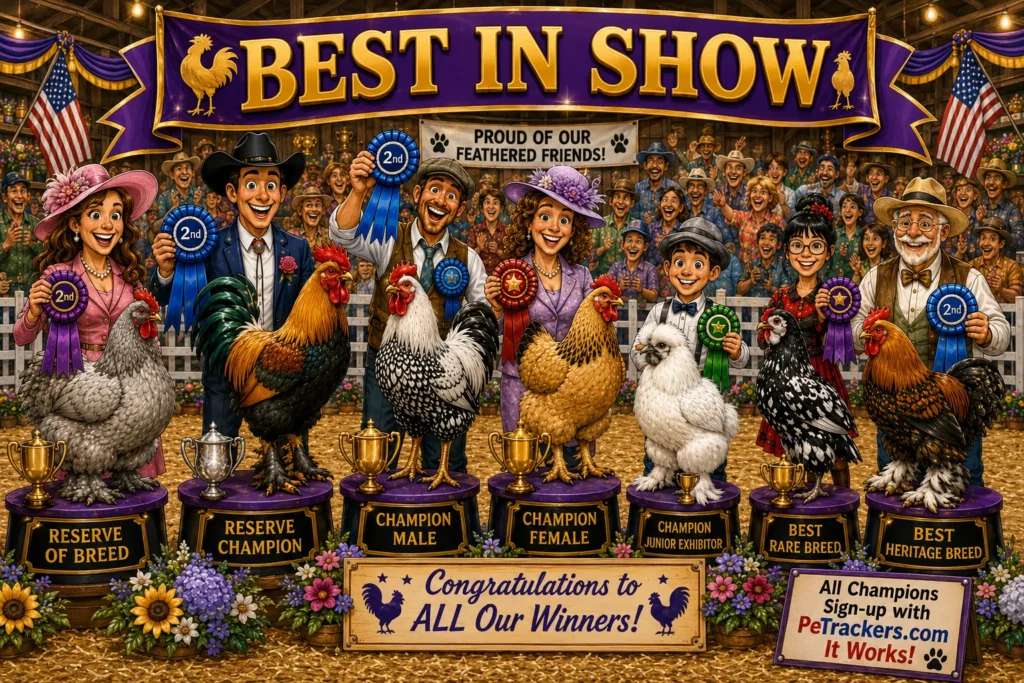
- Reserve of Breed
- Reserve Champion
- Champion Male
- Champion Female
- Champion Junior Exhibitor
- Best Rare Breed
- Best Heritage Breed
A Competition Chicken normally reaches Best in Show only after winning against Competition Chicken birds in its own variety – breed – and larger Chicken competition group.
10. Chicken Judging and Showmanship
Are Different Competitions
Best in Show
In a regular Competition Chicken poultry class the Competition Chicken is primarily judged – in a youth or 4-H showmanship class – the Competition Chicken Handler is judged on:
- Knowledge of the Competition Chicken
- Safe handling of Competition Chicken
- Correct carrying of Competition Chicken
- Presentation of Competition Chicken
- Ability of Judges to examine the of Competition Chicken
- Clean and appropriate appearance of Handler
- Courtesy of Handler
- Attention to the judge of Handler
- Knowledge of poultry care of Handler
Handler showmanship guides commonly emphasize cleanliness – gentle handling – correct posing – following instructions – consideration for other exhibitors.
The ideal Best in Show of Handler is therefore not necessarily the biggest or fanciest Competition Chicken – it is a healthy – naturally presented – exceptionally well-conditioned Chicken – a Competition Chicken most closely represents the official standard for the Competition Chicken’s Breed and Variety.
Your Emergency Photos/Video
You Instantly Released on
PeTrackers.com
Made Finding your Champion Chicken
Quicker and Easier to Find
And Happily Return to You!